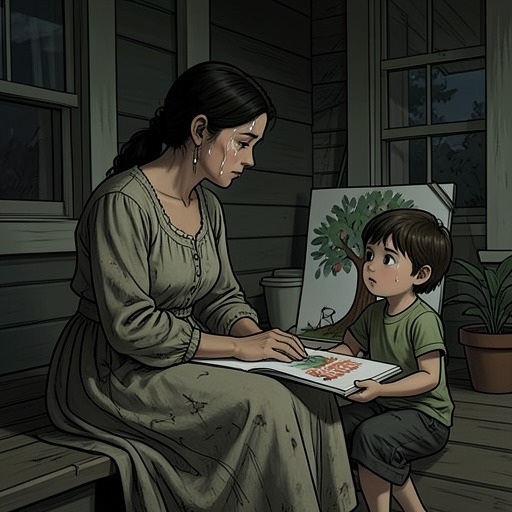
Kya Clark and Maria Jacques (Ma): Mother and Daughter
Where the Crawdads SingKya Clark and Julienne Maria Jacques, known as Ma, are mother and daughter whose relationship is shaped by a departure Kya cannot understand and a bond she cannot relinquish. Ma’s leaving does not erase her from Kya’s life: her voice, art, name, and a letter become the fragments through which Kya holds on to her, while the absence itself shapes Kya’s expectation of family and return.
A Mother in the Marsh Home
Ma is part of the family’s beginnings and of the fragile home she tries to make. She and Jackson Henry Clark married in 1933; later, on their only moonlit boat ride together, they conceived their youngest child. That daughter was named Catherine Danielle, and became known as Kya because that was the name she gave when first asked. The family Bible preserves the formal names and dates: Kya finds herself listed as Miss Catherine Danielle Clark, born October 10, 1945, and reads that Jackson Henry Clark married Julienne Maria Jacques. Until she reaches that entry, she has not known her parents’ proper names. The discovery gives the mother she remembers a fuller identity, placing Ma within a family history Kya had partly lost.
Ma works to establish a household after the family arrives in the marsh. She buys sheets for the floor mattresses and a tin bathtub, washes clothes at the yard spigot, and learns how to plant a garden and keep chickens. For Kya, Ma is also associated with artistic attention and instruction: she paints estuaries and sunsets in oils and watercolors, brings art supplies home, and sometimes lets Kya paint on brown grocery bags. She teaches Kya to value proper speech, correcting her use of ain’t and directing her to listen to the way Orson Welles speaks. These remembered lessons and shared materials make Ma present in Kya’s imagination even after the household has lost her daily care.
The Departure and Its Afterlife
The separation comes when Kya is six. On a morning heavy with August heat and fog, she hears the screen door slap while washing a pot. She knows Ma never lets it slam. From the porch she sees her mother walking down the sandy lane in her only going-out shoes, fake alligator heels, carrying a blue train case. Ma usually goes out and returns with food; the case and the shoes tell Kya that this departure is different. Ma walks on without the familiar wave Kya expects at the place where the footpath meets the road. Kya runs there, but catches only a glimpse of the blue case disappearing among the trees. She returns to the steps to wait.
The departure follows a morning when Ma is quiet, her smile gone and her eyes red. A white scarf tied across her forehead does not fully conceal the purple and yellow edges of a bruise. She packs a few personal things into the train case and leaves before the dishes are washed. The narrative places this visible injury beside Kya’s later memories of Jake Clark beating the family, including an episode in which he attacks Ma and then whips Kya when she tries to intervene. Kya does not understand what the adults are fighting about. She does, however, remember the violence and keep hoping that Ma will return when life with Jake seems temporarily calmer.
That hope persists through the seasons. Kya looks down the lane whenever she steps outside, imagining Ma walking home in the alligator heels. She remembers Ma singing along with the radio and painting, and wonders whether the period when Jake is fishing and talking more calmly might allow the family to begin again. Kya cannot reconcile the mother who left with the mother whose return she awaits; the two remain joined in her mind by the conviction that Ma will not leave her forever.
The Letter and What Remains
In early September, Kya finds a blue envelope at the mailbox, addressed in Ma’s neat handwriting. After so long without a sign of her, the letter tells Kya that Ma is alive somewhere else. Kya can recognize her own name but cannot read the letter, and she cannot open it before Jake returns. She leaves it on the kitchen table, watches it while cooking black-eyed peas, and hides in the outhouse when she hears him arrive.
When Jake leaves for the lagoon, the letter has disappeared. Kya searches his drawers and closet, then finds its ashes in the trash, still edged with blue. She picks through the garbage for words but finds only traces of cinder. The loss is especially complete because even the postmark is gone: the letter could have told her where Ma was, but now neither its message nor its origin can be recovered. Kya saves the black-and-blue ashes in a small bottle in her cigar box. The remnant cannot restore contact, but it preserves the fact that Ma wrote to her and that Ma had touched the paper.
Memory, Names, and an Unfinished Bond
Years later, learning to read enables Kya to recover more of the family’s identity from the Bible. The names turn absent relatives into people she can name again; when she finds Ma’s proper name in the marriage entry, the discovery also revises what Kya knows about her own mother. The book does not show Ma returning or explain the full contents of her letter. Instead, the relationship remains active through memory, the words Ma taught, the pictures she made, and the ashes Kya keeps.
The bond is therefore neither simple reconciliation nor simple erasure. Kya’s longing coexists with evidence that the home was marked by Jake’s violence, and the text does not make Ma’s departure an uncomplicated act of abandonment or supply a complete explanation for it. Kya’s waiting, her preservation of the letter’s remains, and her later recovery of Ma’s name show how a child sustains connection when direct contact and answers are absent. Ma remains at once a remembered caregiver, a source of knowledge and art, and the missing person around whom Kya’s early sense of family is organized.